
Updated on Jan. 17, 2026
Integrated Fascial Stretch & Massage Therapy in Toronto
Assessment-Driven Care: Combining Fascial Stretch Therapy & Massage for Lasting Results

Beyond Cookie-Cutter Treatments: A Fluid, Integrated Approach
If you're searching for solutions to persistent pain or stiffness in downtown Toronto, you've likely experienced treatments that follow a rigid protocol. In my practice across three downtown Toronto clinics—b-Stretched Queen West, b-Stretched Bay Adelaide in the Financial District, and Step Up Massage & Rehab at Adelaide & Duncan—I take a different approach, I practice differently: I integrate Fascial Stretch Therapy (FST) with clinical massage techniques in a fluid, assessment-driven session that responds to what your body needs in real-time.
As both a Registered Massage Therapist (RMT) and a Fascial Stretch Therapist - Level 3, I don't believe in one-size-fits-all solutions. Each session begins with understanding the cause, then employs the right tools—whether that's hands-on massage to address muscular tension or FST techniques to release deeper fascial restrictions.
The 5-Step Process: Understanding Cause Before Treatment
Effective care doesn't start with hands-on work—it starts with understanding. Here's my systematic approach:

Step 1: Your Story – Detailed History & Description
We begin with you telling your story. I listen carefully to your description of the issue—its patterns, triggers, and what you've tried before. This narrative provides the first crucial clues.
Step 2: Physical Investigation – Comprehensive Assessment
With your consent, I conduct specific movement tests and assessments. This helps translate your description into an understanding of the anatomical, biomechanical, or physiological causes. Is it primarily muscular tension? A joint restriction? A fascial adhesion? The assessment aims to find out.
Step 3: Collaborative Planning – Your Custom Treatment Blueprint
Based on our discussion and assessment findings, I explain what I believe is happening and propose a customized treatment plan. We discuss how integrated FST and massage techniques can address the identified causes. Your questions and comfort guide this plan.
Step 4: Adaptive Treatment – Fluid Integration of Techniques
During your session, I may begin with hands-on massage to prepare tense tissues, then seamlessly integrate FST techniques to address fascial restrictions, returning to massage as needed. This isn't a preset routine—it's responsive, intelligent bodywork that adapts to what your body presents.
Step 5: Empowerment – Essential Self-Care & Management
The work continues between sessions. I provide tailored take-home guidance—specific exercises, stretches, or ergonomic adjustments—to help you manage your condition actively. This partnership approach significantly increases the likelihood of lasting improvement.
Why this integrated approach matters: While no therapy guarantees 100% resolution, combining FST's fascial-release capabilities with massage's muscular-focused techniques within a clear assessment framework offers a more comprehensive path to improvement than either modality alone.
How Integrated Sessions Work: FST + Massage in Practice
Many clinics offer either massage or assisted stretching. My practice is built on the principle that these are complementary tools, not separate services.
The Integration in Action: A client with chronic shoulder pain might receive massage to release tight rotator cuff muscles, followed by FST to address the fascial restrictions in the shoulder girdle that were contributing to the muscular tension. The modalities work together to address different layers of the same issue.
Who Benefits from This Combined Approach?
This integrated method is particularly effective for:
- Downtown Professionals with Desk-Related Pain – For those in the Financial District, King West or Queen West experiencing neck, shoulder, and low-back pain from prolonged sitting. We address both the muscular tightness and the fascial shortening that develops.
- Athletes with Performance Plateaus or Recurring Issues – Runners, cyclists, and gym-goers dealing with IT band syndrome, shoulder impingement, or chronic tightness benefit from improved tissue pliability (FST) and specific muscular balance (massage).
- Individuals with Chronic, Complex Pain – When pain has persisted despite other treatments, a cause-focused assessment and combined approach can address both tissue damage and protective fascial guarding.
- Post-Rehabilitation Clients – To manage scar tissue adhesion (FST) and restore normal muscle function (massage) after surgery or completing physiotherapy.
Why Choose This Integrated Practice?

In a landscape of quick fixes and standardized protocols, this practice stands for deliberate, educated care.
Dual Credentials, Focused Expertise: As a Registered Massage Therapist (regulated by the CMTO) and a certification in Fascial Stretch Therapy Level 3, I bring a unique skill set to Toronto. My practice is grounded in rigorous anatomy knowledge while specializing in fascial health.
Assessment-Driven Philosophy: I'm motivated by solving puzzles, not following routines. Your treatment is a custom-built solution based on clear assessment findings, not a pre-set protocol.
Toronto Clinic Convenience: Available at b-Stretched Queen West, b-Stretched Bay Adelaide in the Financial District (accessible via PATH) and Step Up Massage and Rehab (Adelaide).
Ready for Assessment-Driven Care?
If you're in Toronto and seeking a therapeutic approach that adapts to your unique needs—combining the precision of FST with the relief of massage—I invite you to begin with a comprehensive assessment.
Available at all downtown Toronto locations
You may be interested in:
What is Myofascial Release (MFR)
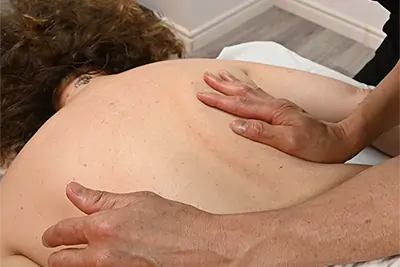
Myofascial release (MFR) therapy is a massage technique that releases fascia tension. Accumulated unresolved fascial tension can develop into myofascial pain.
The myofascial release technique is the manipulation of soft tissue with a sustained and appropriate amount of pressure to release fascial adhesions and trigger points. The pressure is applied horizontally along the fascia's direction to stretch and lengthen the fascia, therefore breaking down the adhesion and trigger points.
Your Pain Is Personal to Me: How My Own Injury Led Me to Becoming RMT
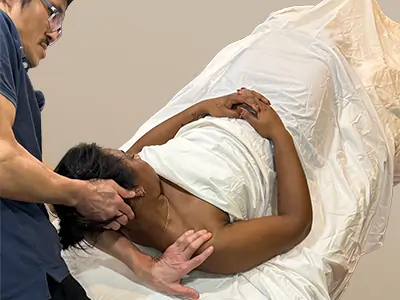
A personal narrative from Registered Massage Therapist Kin Sze about how his own hamstring injury and career transition from engineering to massage therapy inform his empathetic, whole-body approach to treating neck and shoulder pain in Toronto.